


Frequently asked customer questions
Our team is dedicated to providing a safe, comfortable, and informative experience, and we’re happy to answer any additional questions you may have before starting treatment.
Why is Oxygen so Important?
Oxygen is a colorless, odorless gas that makes up about 21 percent of the atmosphere. It is essential to life for two reasons: Oxygen is one of the body’s basic building blocks. All of the body’s major components, water, protein, carbohydrate and fat contain oxygen. Oxygen helps bring about certain chemical reactions within the body that result in energy production. Energy is needed for functions such as circulation, respiration and digestion. Energy is also used to maintain a constant body temperature.
How does HBOT allow more oxygen to be absorbed into the bloodstream and tissues?
Blood is made up of three main components: white blood cells that fight infection, red blood cells that carry oxygen, and plasma, the fluid that carries both kinds of cells throughout the body. Under normal circumstances, only the red blood cells carry oxygen. However, because HBOT allows more oxygen into the body under pressure, oxygen dissolves into all of the body’s fluids, including the plasma, the lymphatic fluids, and the cerebrospinal fluids surrounding the brain and spinal cord. These fluids can carry the extra oxygen even to areas where circulation is poor or blocked, either by trickling past the blockages or by seeping into the affected area. This extra oxygen helps in the healing process and enhances the white blood cells’ ability to fight infection. It can promote the development of new capillaries, the tiny blood vessels that connect arteries to veins. It also helps the body build new connective tissue. In addition, HBOT helps the organs function in a normal manner. Recent studies from the University of Pennsylvania School of Medicine are showing that a typical course of HBOT increases by eight-fold the number of stem cells circulating in a patient’s body. Stem cells are crucial to injury repair.
What are the Properties of HBOT
- Oxygenates, repairs and regenerates tissue.
- Fights infection
- Grows new capillaries
- Increases stem cell production
- Highly reduces the “inflammatory reaction”
What is HBOT?
Hyperbaric Oxygen Therapy “HBOT” is a medical treatment in which a person breathes 100% oxygen while under increased pressure. Basically, the patient is breathing oxygen at levels far greater than that which is found at a normal room atmosphere. HBOT allows more life-sustaining oxygen to be delivered to the tissues and organs. This increase of oxygen at the cellular level accelerates the healing processes and assists in the recovery of numerous conditions. “Hyper” means increased and “baric” relates to pressure.
What is a treatment like?
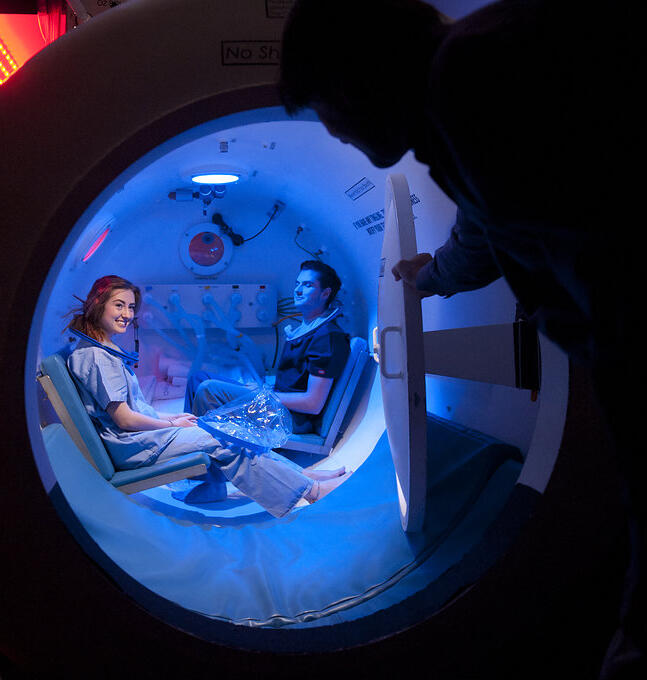
A HYPERBARICS treatment is given in a mono-place (single occupancy) chamber. During treatment, the patient can relax by watching a movie, listening to music or just rest. It is a non-invasive, safe method of administering pure oxygen at greater than atmospheric pressure to a patient in order to improve or correct certain conditions. Providing oxygen in a pressurized chamber allows the delivery of 10-15 times more oxygen than if it was delivered at sea level or at normal atmospheric pressures.
Is HBOT safe?
HBOT is SAFE. Side effects are minimal and rarely last a long time. Hyperbaric Oxygen is not always a cure but it has been clearly demonstrated to dramatically increase immune capabilities, assisting patients with problems ranging from chronic wounds to complex disabilities and neurological impairment. Taking this information into account there are currently 16 approved indications in America.
What are the FDA approved uses for HBOT?
Air Gas embolism
Brown recluse spider bites
Carbon Monoxide or Cyanide poisoning
Gangrene
Crush injury, compartment syndrome and other acute traumatic ischemias
Decompression sickness
Enhancement of healing in selected problems wounds such as: Diabetically derived illness, such as diabetic foot, diabetic retinopathy, diabetic nepropathy.
Exceptional blood loss (anemia)
Intracranial abscess
Necrotizing soft tissue infections (necrotizing fascilitis)
Osteomyelitis (refractory)
Delayed radiation injury ( soft tissue and bony necrosis)
Skin grafts and flaps (compromised)
Thermal burns
Central retinal artery occlusion
Idiopathic sudden sensorineural hearing loss
Resources
Hyperbaric oxygen therapy is a widely-accepted treatment and has been proven to help improve many medical conditions.
HBOT & Alzheimer's
Hyperbaric oxygen therapy as a new treatment approach for Alzheimer’s disease (AD): Alongside the increase in life expectancy, the prevalence of age-related disorders, such as neurodegenerative diseases, is on the rise.
HBOT & Stroke
Stroke is one of the leading causes of death and the leading cause of long-term disability in the United States. Strokes occur when a blood vessel is blocked or bursts suddenly.
HBOT & Chronic Wounds
A thesis submitted to the University of Plymouth in partial fulfillment for the degree of DOCTOR OF PHILOSOPHY School of Biomedical and Biological Sciences Faculty of Science and Technology
HBOT & Inflammation
Hay fever, heart disease, depression, and diabetes…four very different conditions with one common denominator: Inflammation is at the root of all four. And that’s just the beginning! “Researchers are linking inflammation to an ever-wider array of chronic illnesses,” reports Newsweek’s Anne Underwood.
HBOT & Your Heart
Recognition of oxygen’s physiological importance is age-old knowledge, but only recently has medical science provided us with guidelines as to how much and when. Simple cause and effect has been the basis of most of our past wisdom.
HBOT & Parkinsons
A case study of five patients with a history of Parkinson’s Disease (PD) were treated with Hyperbaric Oxygen Therapy (HBOT) for 1 hour at 1.5-2.0 ATA. All 5 patients reported a decrease in tremors and an improvement in general well-being.
HBOT & Recovery From Near-fatal Drowning
A case study of five patients with a history of Parkinson’s Disease (PD) were treated with Hyperbaric Oxygen Therapy (HBOT) for 1 hour at 1.5-2.0 ATA. All 5 patients reported a decrease in tremors and an improvement in general well-being.